📈#069: How e-wallets are quietly crushing credit cards
...and what the trends mean for you (the numbers will shock you) 📊
Welcome to Market Mosaic, where, in this week's edition, we analyse the massive infrastructure investments powering digital transformation and explore how India's economic ascent is redefining global consumer markets.
We also look at how e-wallets are challenging transaction economics while strategic caution dominates corporate deal-making.
Let’s dive into the market reality check!
— Insights Team, Rwazi
In our edition this week:
Sector Performance Tracker
Technology
Economy
Consumer Universe
Supply Chain
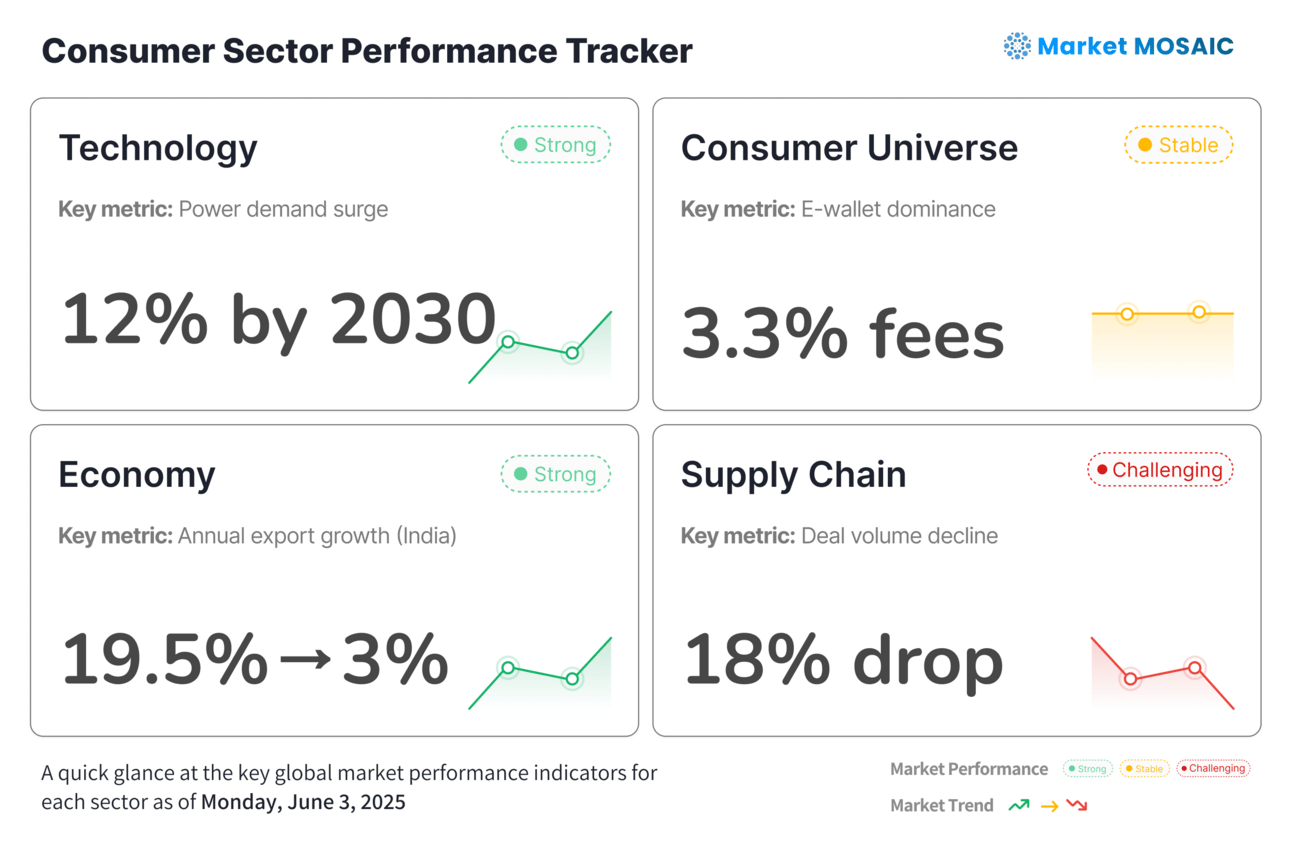
This weekly market snapshot was compiled and analysed by Rwazi Insights
TECHNOLOGY
The power-hungry future of digital infrastructure in the U.S.
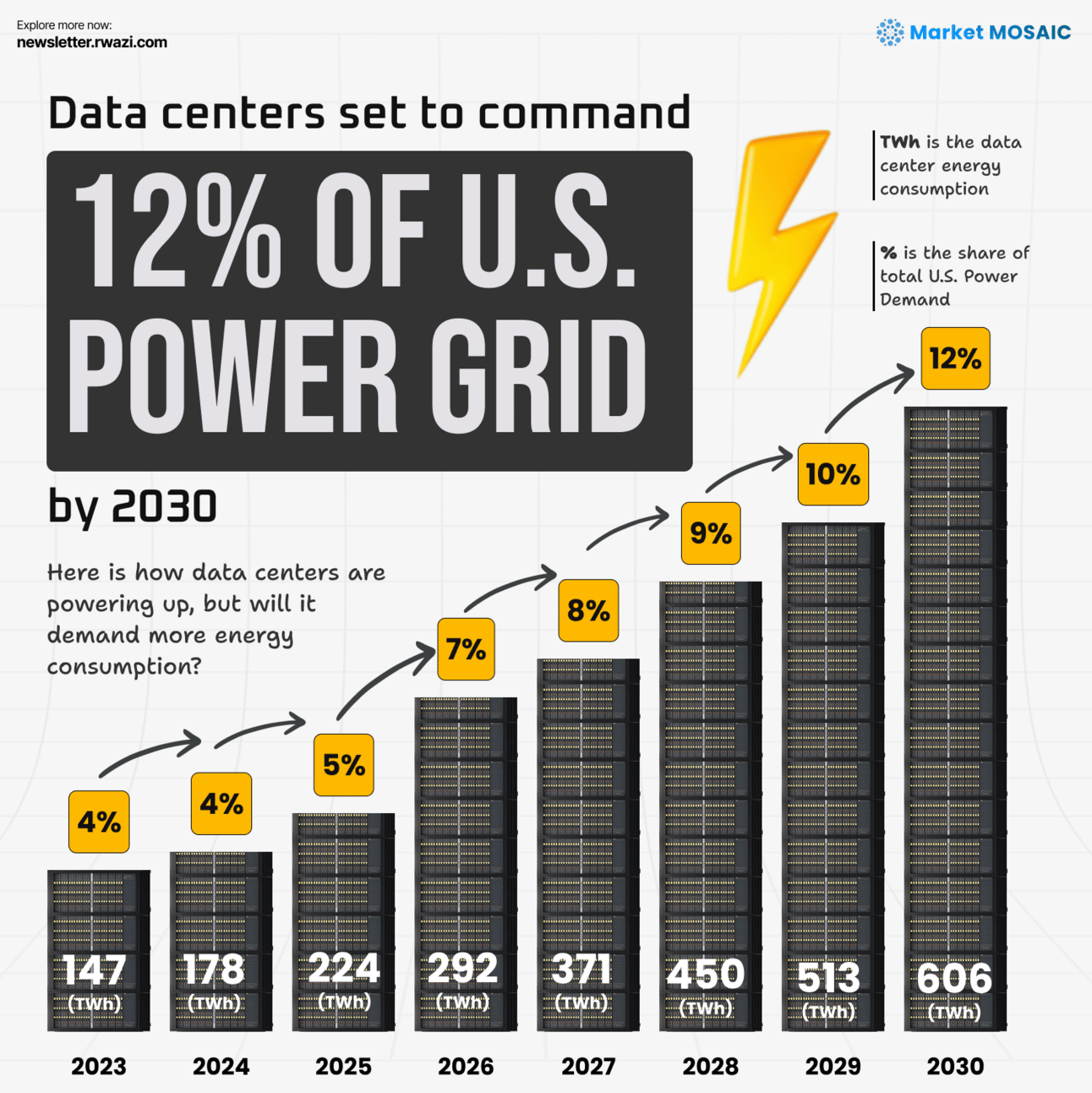
Chart by Rwazi Insights for Market Mosaic
The digital transformation driving consumer experiences comes with a massive hidden cost: energy consumption. And according to analysis by Market Mosaic, data centres in the United States will consume 606 terawatt-hours of energy, 12% of the nation's power by 2030, up from just 3% today, equivalent to powering 57 million homes annually.
For consumers, this infrastructure buildout translates to both opportunities and challenges. The $500 billion investment required to meet this demand will likely drive innovation in renewable energy solutions and smart grid technologies. However, it also signals potential increases in digital service costs as companies factor in rising energy expenses.
The consumer behaviour driving this surge is clear: demand for AI-powered personalisation, cloud gaming, streaming services, and instant digital interactions continues to accelerate as consumers now expect sub-second response times from digital applications.
The exponential growth in data centre power consumption reflects consumers' insatiable appetite for digital experiences, but will ultimately reshape pricing models and sustainability strategies across the tech sector.
ECONOMY
India's export slowdown rebounces
Market Mosaic believes India's journey from the world's 16th largest economy in 1997 to its projected 4th place ranking in 2025 is one of the most significant global economic transformations this decade. However, beneath this impressive growth lies a more complex story of export challenges and its consumer market.
While India's economy continues its upward trajectory, goods’ exports have plateaued, growing at only 3% annually since 2011 compared to 19.5% from 1999-2011. This shift reflects India's transition toward a services and domestic consumption-driven economy, creating massive opportunities for consumer brands.
With over 1.4 billion consumers and a fast-expanding middle class, India is now the world's largest untapped consumer market. Analysis by Market Mosaic shows that Indian consumers are increasingly embracing digital-first experiences, sustainable products, and premium brands.
These trends will reshape global consumer goods strategies as India's economic rise signals a fundamental shift from export-led to consumption-led growth. This will then create unprecedented opportunities for global brands that can successfully navigate this diverse and fast-rising consumer markets.
CONSUMER UNIVERSE
E-wallets are transforming the transaction economics/p>

The global payments are experiencing a major shift that impacts both retailers and consumers. E-wallet services now charge significantly lower fees than traditional credit cards, with platforms like Alipay (0.55%) and WeChat Pay (0.60%) leading.
This fee differential has implications for consumer behaviour and market dynamics. In places like China, e-wallets account for 56% of transaction value compared to just 18% for credit cards. The lower transaction costs enable retailers to offer better prices or invest more in customer experience, creating a cycle of adoption.
For consumers, e-wallets offer not just convenience but also access to integrated financial services, loyalty programs, and personalised offers that traditional payment methods cannot match.
The dominance of low-fee e-wallet services is reshaping retail economics and consumer expectations, creating competitive advantages for markets that embrace digital payment innovation over traditional card-based systems.
SUPPLY CHAIN
Mergers and acquisitions (M&A) caution reflects consumer uncertainty

The selective M&A environment indicates that companies are prioritising organic growth and operational efficiency over expansion through acquisition, suggesting a more mature approach to building consumer-centric businesses
Thank you for reading and joining us on Market Mosaic this week. We hope this edition provides valuable, actionable insights for decisions with data. 📊
Create your account on Rwazi now