
📈#068: 50% price hikes & 66% AI concentration signal massive market shifts ahead
...and why your business strategy needs urgent revision 📊
Welcome to Market Mosaic, where, in this week's edition, we dig into the shift of AI investment concentration as Beijing overtakes Silicon Valley with 66.2% of venture funding and explore how a commanding 33% share of global energy consumption signals an unprecedented consumer market expansion while economic projections show Asia's $57+ trillion dominance by 2075.
— Insights Team, Rwazi
In our edition this week:
Sector Performance Tracker
Technology
Economy
Consumer Universe
Supply Chain
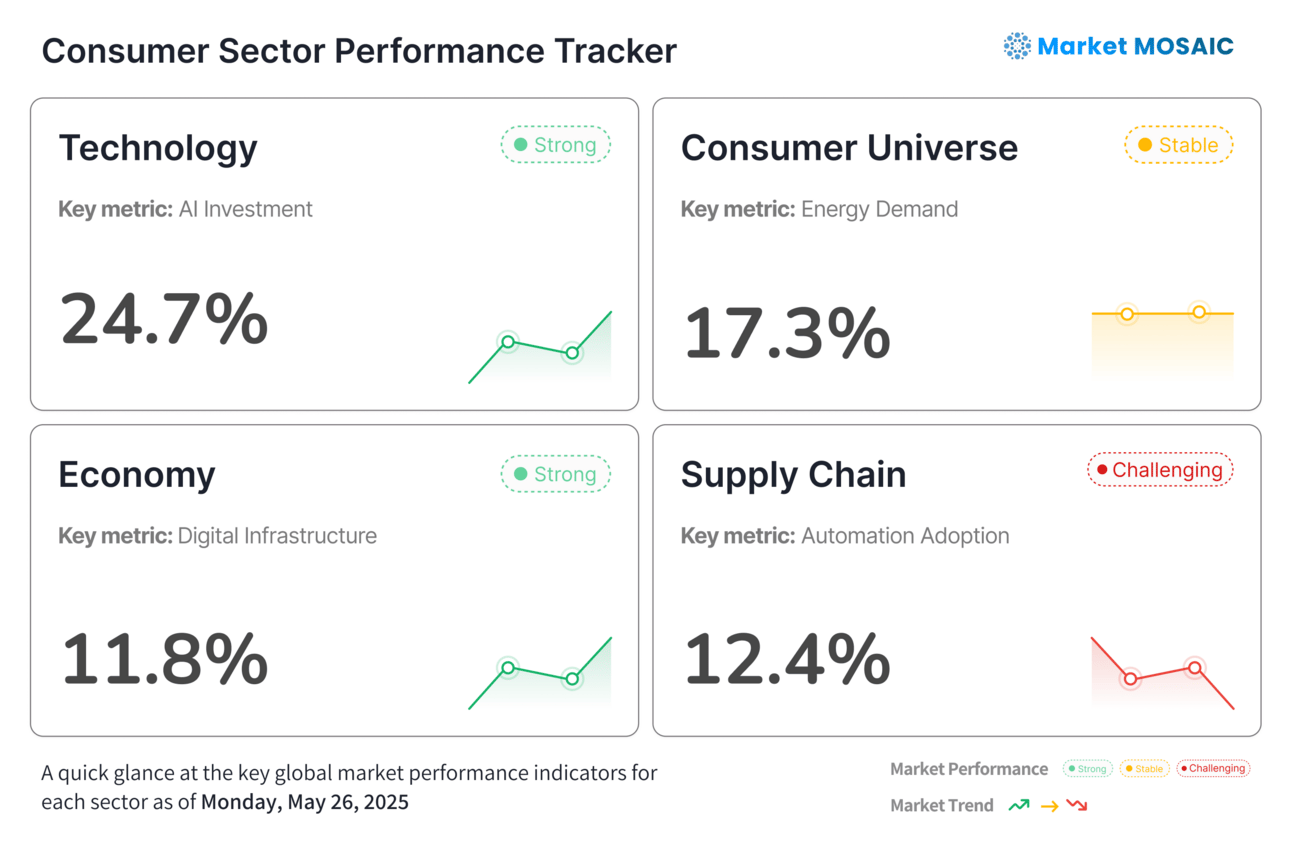
This weekly market snapshot was compiled and analysed by Rwazi Insights
TECHNOLOGY
Beijing emerges as AI investment capital while Silicon Valley dominates dollar volume

Our analysis of global venture funding data reveals a fascinating shift in AI investment patterns across major tech hubs. Beijing now leads the world in AI deal concentration, with an impressive 66.2% of all venture funding going to AI-native companies, narrowly edging out Silicon Valley's 62.4%.
This geographic redistribution of AI investment tells a compelling story about consumer expectations and market demand. Toronto-Waterloo ranks third at 50.3%, followed by Paris at 43.2%, demonstrating that AI innovation is becoming truly global. What's particularly striking is how traditional tech centres like New York (14.2%) and Seattle (14.8%) lag significantly behind in AI-specific investment concentration.
The consumer implications are profound. Cities with higher AI investment concentration are developing more sophisticated AI-powered services and applications that enhance customer experiences. From AI-driven personalisation in e-commerce to predictive healthcare services, these hubs are creating the consumer technologies of tomorrow.
The geographic concentration of AI investment is creating distinct regional advantages in consumer-facing AI applications, with Beijing and Silicon Valley emerging as the primary innovation centers shaping global AI-powered consumer experiences.
ECONOMY
Asia's economic rise will challenge global consumer markets by 2075
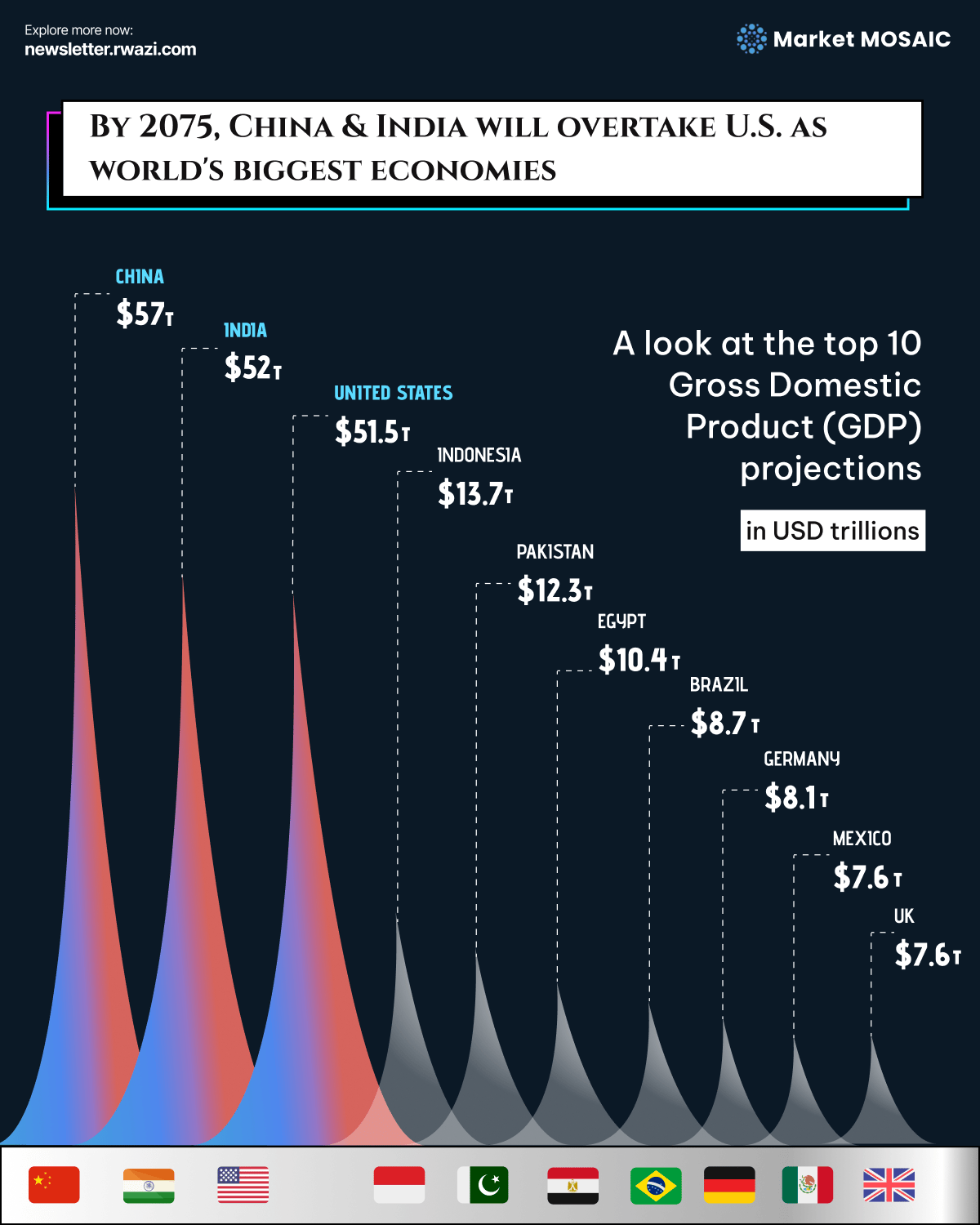
Chart and infographic by Rwazi Insights
Long-term economic projections reveal a dramatic shift in global purchasing power that will fundamentally alter consumer markets. By 2075, China is projected to reach $57 trillion in GDP, closely followed by India at $52.5 trillion, while the United States is expected to maintain $51.5 trillion.
This economic rebalancing represents one of the most significant consumer market opportunities in modern history. The rise of Asia's middle class will create unprecedented demand for goods and services across all sectors. Indonesia ($13.7T), Pakistan ($12.3T), and Nigeria ($13.1T) are emerging as major economies, signalling the birth of massive new consumer bases that companies must prepare for today.
For businesses, this projection suggests a fundamental shift in market strategy is necessary. The next 50 years will see the centre of global consumer demand move decisively toward Asia and emerging markets, requiring companies to adapt products, services, and marketing approaches to diverse cultural preferences and economic conditions.
The projected economic transformation by 2075 demands immediate strategic planning, as tomorrow's largest consumer markets are already forming in Asia and emerging economies that will drive global demand patterns.
CONSUMER UNIVERSE
Energy dominance reflects unprecedented consumer scale

Our data analysis of global electricity consumption shows China's consumer market expansion, with the country now accounting for 33% of worldwide electricity demand at 10,066 TWh. This represents a significant increase from 28% just five years ago, demonstrating sustained economic growth that outpaces global averages.
The electricity consumption patterns directly correlate with consumer behaviour and industrial activity. China's growing share reflects not just manufacturing capacity but also rising consumer consumption of energy-intensive goods and services. The United States (14%), European Union (9%), and India (7%) round out the major consumers, but none match China's growth trajectory.
This energy consumption pattern provides crucial insights into where consumer spending power is concentrated globally. Higher electricity demand typically indicates increased industrial production, urbanisation, and consumer purchasing power—all key indicators for market opportunity assessment.
China's disproportionate and growing share of global electricity consumption signals the world's largest consumer market continuing to expand, creating massive opportunities for businesses that can successfully navigate this complex but rewarding market.
SUPPLY CHAIN
From convenience to market control

Supply chain innovation can evolve from competitive advantage to a market control mechanism. Amazon's FBA program has irreversibly elevated consumer delivery expectations across all e-commerce, forcing retailers worldwide to invest heavily in logistics capabilities to remain competitive.
Thank you for reading and joining us on Market Mosaic this week. We hope this edition provides valuable, actionable insights for decisions with data. 📊
Create your Rwazi account now