📈#111: U.S. data center market share just changed with Texas +142%, Virginia -35%.
📊 Plus: Amazon's indefinite fee hike, $44B in food deals, and the tariff cost hitting consumers next.
Welcome to yet another insightful edition of Market Mosaic.
In case you missed it last week, our latest edition of Global Market Outlook Report went live. It is the most comprehensive market intelligence resource we have ever produced.
Read the 2026 Global Market Outlook Report →
Now, let's dive into the insights.
— Insights Team, Rwazi
Technology
Economy
Consumer Universe
Supply Chain
Texas +142%. Virginia -35%. The global data centre map is being redrawn.
Chart: Expected change in U.S. data centre market share by state — Texas +142%, Georgia +75%, Rest of U.S. +21%, Virginia -35%, California -50%, Oregon -67%, Nebraska -75%. Data visualisation by Rwazi Insights
Virginia has built a two-decade dominance as the world's largest data centre market. By 2028, it is projected to lose over a third of its relative share.
The reason is power, as its grid cannot keep pace with AI workload demand, and utilities have begun imposing moratoriums on new connections.
Texas absorbs the gain. Abundant land, a deregulated grid with significant renewable capacity, and aggressive state-level courting of hyperscaler investment have made it the destination of choice.
Georgia follows at +75%. California loses 50%. Oregon loses 67%. The pattern is the same everywhere capital is leaving: legacy concentration, power constraints, and rising costs equal redirection.
Key Insights 💡
The shift from Virginia to Texas is not a real estate story, it is a direct input into the future cost of computing for every business running AI workloads on cloud infrastructure.
The geographic decisions being made now will lock in cost structures for the next decade.
$44B in food M&A. Q1 was the most active CPG quarter in years.
Unilever spun off its food business to combine with McCormick in a $44.8 billion deal, uniting Hellmann's and Knorr with Cholula and McCormick's spice portfolio.
Kraft Heinz abandoned its split plan entirely, choosing instead to invest $600 million in marketing and R&D. Henkel acquired both Not Your Mother's and Olaplex, betting $1.4 billion on prestige hair care, the fastest-growing segment in beauty at 8% growth in 2025.
Key Insights 💡
Every deal in Q1 follows the same logic: organic growth in mature categories is too slow to justify unfocused portfolios.
The companies gaining ground are moving into high-growth adjacent categories rather than defending where volume has stalled.
🌍 LAUNCHING TODAY: 2026 Global Market Outlook Report
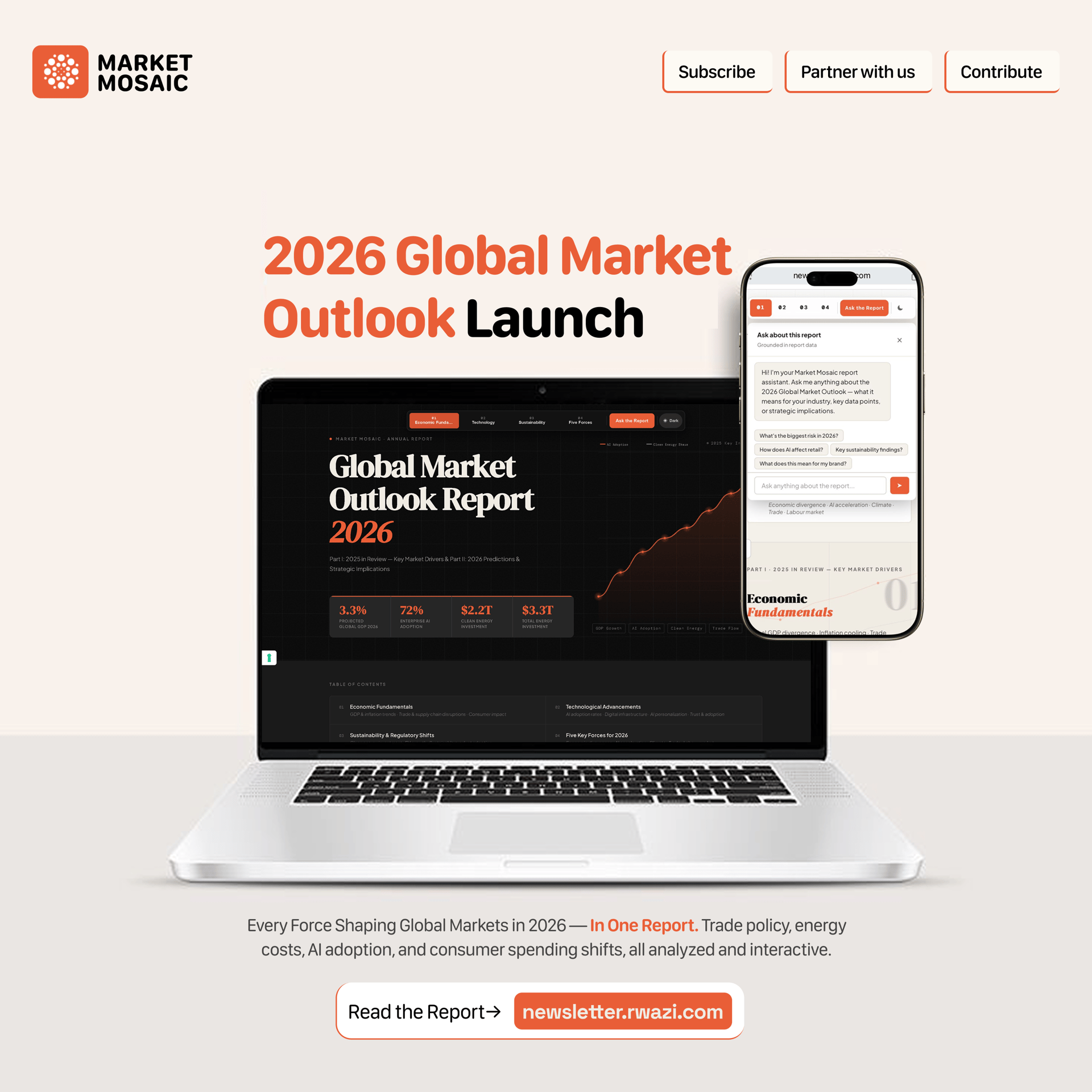
Everything reshaping global markets in 2026, all in one place.
Our 2026 Global Market Outlook Report covers the macro forces every executive and business leader needs to understand right now and know where the next wave of global market opportunity is forming.
US consumers are bearing a third of tariff costs today
Retailers are currently absorbing most of the tariff-induced cost increases to protect consumer relationships. The European Central Bank says that capacity is running out.
As retailers' margins erode, shoppers will bear over half of the total increases, up from roughly a third today. Foreign firms bear just 5%. The Federal Reserve Bank of New York found 94% of tariff costs fell on US importers in 2025. The Tax Foundation estimates an average household increase of $600 in 2026.
Retailers know it. Target cut prices on 3,000 items. PepsiCo repriced its snacks. But preference does not override economics indefinitely.
Key Insights 💡
The shift from a third to over half is not a prediction, it is the natural endpoint of an absorption cycle that cannot hold.
The brands investing now in value messaging and pack size flexibility are positioning for the moment retailers' capacity runs out.
Amazon added a 3.5% FBA surcharge. No end date.
Effective April 17, Amazon adds a fuel and logistics surcharge for US and Canada FBA sellers, roughly 17 cents per unit on average. From May 2, it extends to Buy With Prime and Multi-Channel Fulfilment.
Amazon says its rate is lower than rivals, UPS raised prices 8%, and the US Postal Service matched that figure. What Amazon did not provide is an end date, signalling the energy shock is expected to persist.
The surcharge is added to an 8-cent FBA fee increase effective January 2026. For merchants already carrying tariff burdens and rising input costs, the cumulative pressure is significant. The era of logistics as a competitive subsidy is ending.
Key Insights 💡
Amazon's indefinite surcharge is the moment to model fulfilment diversification. Merchants with no alternatives to FBA have no leverage. Those who start that conversation before April 17 do.
58% of executives get this wrong. 📉
Amazon adds a 3.5% FBA surcharge with no end date. What is your first move?
Raise prices to pass the cost to consumers. / Absorb it and protect volume. / Model fulfilment alternatives now. / Reduce SKU count to cut exposure.
Take our 60-Second Market Instinct Quiz →